When I joined the work of Fund for Shared Insight as a representative of the W.K. Kellogg Foundation (WKKF), I understood the promise of the collaborative immediately: philanthropy could be more effective, more accountable, and more transformative if funders and nonprofits truly listened to the people and communities they aimed to serve.
That promise mattered to me deeply. But from the beginning, I also understood something else: listening alone is not enough.
Listening can be a doorway to change, but only if it is grounded in a clear commitment to racial equity, a willingness to address historical and present-day power imbalances, and the courage to let communities shape the work with us. Without that, listening can become just another process; another way to gather information without changing relationships, decisions, or outcomes. That conviction shaped my role in Shared Insight and remains one of the reasons I see the collaborative journey as so important.
Bringing racial equity to the center
In Shared Insight’s early years, funders came together around a shared interest in feedback and listening, but not necessarily a shared understanding of how race, equity, and power fit into that work. There were moments when I felt I was one of the few consistently naming the importance of racial equity in explicit terms. At times, even saying the words made some fellow funders uncomfortable. But from my own personal perspective, and from the perspective I brought from WKKF, there was no credible path to high-quality listening without naming the systems that had determined whose voices were heard, whose knowledge was valued, and whose lives were too often ignored.
At WKKF, we understand this work through the lens of RECE: Racial Equity, Community Engagement, and Racial Healing. Those principles shaped how I showed up at Shared Insight. They also helped me ask different questions. Not easy questions, but necessary:
- Who is being listened to, and who is still being overlooked?
- How are race and structural inequity shaping what is possible?
- What would it take for communities not only to be heard, but to help define the path forward?
- And what must funders unlearn in order to truly shift power?
Over time, Shared Insight’s language and practice evolved. What may have initially been described through EDI (Equity, Diversity, and Inclusion) language became more explicitly grounded in what I would describe today as REDI: Racial Equity, Diversity, and Inclusion. But even REDI, while essential, was not sufficient on its own. The W.K. Kellogg Foundation’s RECE principles offered an even fuller frame. Through that lens, we came to understand that equity work is not only about systems and representation. It is also about healing. It is about understanding that trauma lives inside institutions, relationships, and communities, not just inside individuals. And if philanthropy is serious about changing systems, it must also be willing to confront the trauma those systems have caused and the trauma they continue to produce.
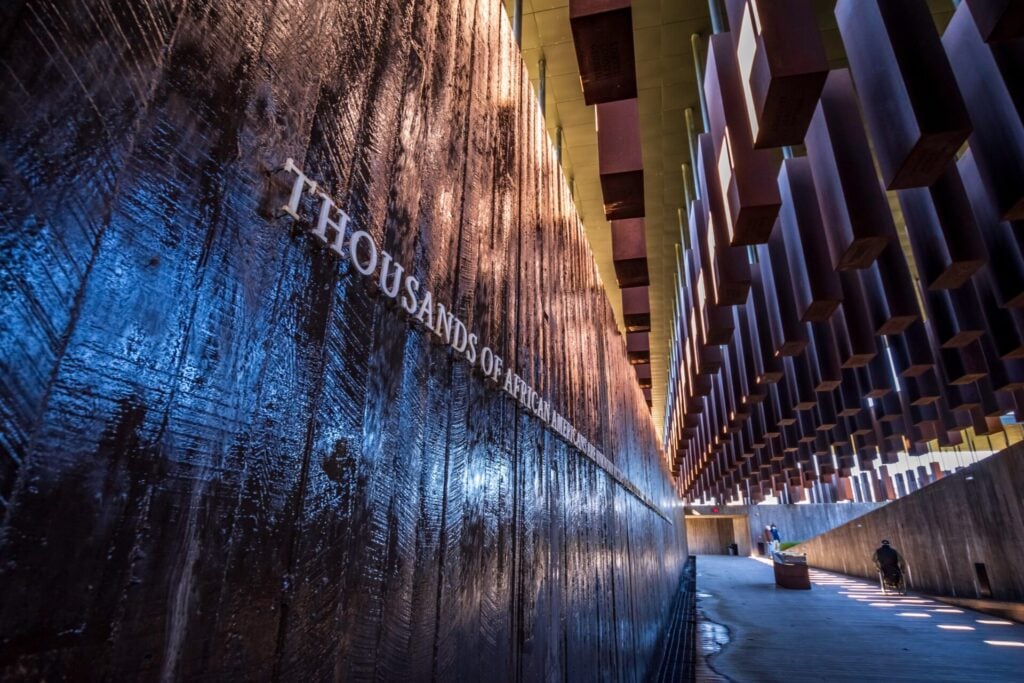
That understanding became especially clear during Shared Insight’s 2018 visit to Montgomery, Alabama. The visit to the Legacy Museum and the National Memorial for Peace and Justice was a turning point. Many of us arrived with an intellectual understanding of structural racism. We left with something much more embodied. Montgomery made visible the continuum from slavery to racial terror to mass incarceration. It placed history, pain, and policy in direct relationship with one another. For me, and for others in the collaborative, it deepened the recognition that racial healing must accompany structural change. We could no longer speak of systems transformation without acknowledging the trauma embedded within those systems.
That trip moved our understanding of equity from conceptual to lived. It helped the group recognize that racial equity and racial healing are both necessary, not only for process, but for meaningful outcomes. It also deepened our understanding of what shifting power really requires. Before Montgomery, listening could still be framed as a funder practice, something philanthropy does better or worse. After Montgomery, it became harder to ignore that a genuine power shift requires something more: co-creation with community, listening to the beneficiaries of our funding. That was one of the most important shifts I witnessed in Shared Insight. We began to move from asking, “How do funders listen better?” to asking, “How do communities shape the decisions that affect their lives?” That is a fundamentally different question.
We began to move from asking, “How do funders listen better?” to asking, “How do communities shape the decisions that affect their lives?” That is a fundamentally different question
The RECE principles I carried from WKKF were never just theoretical for me. They shaped how I interpreted Shared Insight’s work and what I advocated for inside it. Shared Insight’s evolution toward a race-explicit theory of change reflected years of learning, tension, and persistence. The work became stronger once we acknowledged that listening is not inherently inclusive. It only becomes transformative when it is connected to racial equity and a commitment to dismantling systems that marginalize communities.
One of the most important lessons from Shared Insight was that listening is not the same as community engagement. Listening can still happen at a distance. Community engagement, by contrast, requires relationship, humility, accountability, and the willingness to let community wisdom influence strategy and decision making. That distinction mattered deeply to me. It is also one of the clearest ways WKKF’s RECE principles informed my leadership within the collaborative.
Shared Insight’s journey affirmed something I have long believed: healing is not separate from philanthropy’s work; it is central to it. When we are dealing with legacies of exclusion, extraction, and racial harm, technical solutions alone will not get us there. We need practices that help us build trust, repair relationships, and acknowledge pain while creating the conditions for something new to emerge.
One of Shared Insight’s greatest contributions was helping philanthropy understand that listening, by itself, is not virtuous. Listening without action, without accountability, and without a willingness to shift decision-making authority is simply another version of maintaining the status quo. That lesson became especially visible in the collaborative’s later work around participatory philanthropy and in its support for initiatives that challenged the sector to move beyond funder-centric habits. While those efforts had mixed results, they were important because they helped surface the reality that power is hard to shift, especially in philanthropy, where control is often mistaken for stewardship.
Continuing to raise the tension; hold up racial equity
My role in Shared Insight was, in many ways, to keep raising that tension: to hold up racial equity, to ask how community was shaping the work, and to remind the collaborative that the goal was not better process for funders, but better relationships, better decisions, and ultimately better outcomes because power had truly moved.
As Fund for Shared Insight sunsets, I see its legacy not only in the tools, evaluations, and initiatives it produced, but in the deeper shift it helped catalyze. It helped philanthropy understand that:
- feedback is not enough without equity,
- listening is not enough without action,
- and action is not enough without healing and power-sharing.
For me, that is where the role of W.K. Kellogg Foundation’s RECE principles was most meaningful. They helped expand the frame. They made visible that the work is not only about feedback systems or foundation openness. It is about how philanthropy becomes more human, more just, and more accountable to those at the heart of its mission.
I am proud to have contributed to that journey.
And I remain convinced that the future of philanthropy depends on whether we are willing to do all three: listen deeply, learn honestly, and let go of the power we were never meant to hold alone.
About the author: