Over the past decade, nonprofits, foundations, and philanthropy infrastructure organizations have increasingly spotlighted participatory approaches to philanthropy as mechanisms for advancing equity and redistributing power to directly impacted communities. Efforts by Fund for Shared Insight and other groups, such as the Participatory Grantmaking Community, and Trust-Based Philanthropy, have supported foundations’ ability to advance community listening as a means to improve conditions in ways communities define for themselves.
Among these methods, participatory grantmaking has generated considerable interest as a means to shift traditional power dynamics. Grantmakers for Effective Organization’s “2025 National Study of Philanthropic Practice” found that 42% of grantmakers report engaging in participatory grantmaking. Although we

Read the ORS Impact publication
do not know much about the quality or nature of these funders’ work, this survey, along with the continued growth of the Participatory Grantmaking Community, suggests increasing interest in and uptake of the practice.
Participatory grantmaking is defined by GrantCraft as ‘a grantmaking approach that cedes decision-making power about funding — including the strategy and criteria behind those decisions — to the very communities that funders aim to serve.’
We are encouraged by these trends and see opportunities to further advance the sector’s dialogue and understanding of participatory grantmaking. Having evaluated or documented such initiatives in recent years in partnership with Shared Insight, the Denver Foundation, and the Hellman Foundation, we have seen how it plays out in different contexts. This work, along with an additional ORS Impact study of participatory methods among 11 foundations, helped us develop hypotheses about what it would take to effectively increase uptake of participatory grantmaking practices within and across foundations.
Based on the diffusion of innovations theory, it appears that participatory grantmaking practices have been adopted by early adopters. Now, to expand uptake and ensure that broader adoption is rooted in best practices, we believe the field needs to better understand the approach and create clear standards to guide how key actors design and implement it. To do this, we must learn as a sector more intentionally.
ORS Impact published “A Framework to Evaluate Participatory Grantmaking” to support dialogue and learning, and to make the case that better evaluation is essential to building a stronger research base and deepening our collective understanding of participatory grantmaking. Through the framework, we provide a practical tool to examine and learn from participatory grantmaking so that we can see how and to what extent listening is transforming philanthropy and communities. We believe that participatory grantmaking is more likely to live up to its transformative promise if foundations and practitioners are committed to intentional and systematic learning.
Assessing design and impact
To date, many of the publicly available reviews of participatory grantmaking have focused on the structure of the process: who participates, how advisory committees are formed, and the extent to which participants were satisfied by the experience. These elements matter, but they are not sufficient to understand the totality of what participatory grantmaking accomplishes. Focusing solely on design and process does not do justice to the full potential of participatory practices.
The evaluation framework we developed proposes that we examine outcomes of participatory grantmaking programs across three related, but distinct audiences typically involved: the participants providing input into decision making, the foundation and its staff, and the broader community the initiative seeks to support. The framework then invites us to explore three different types of outcomes across these audiences: the process of the initiative, the results of the initiative, and its effects on the broader community.
Participatory grantmaking evaluation framework
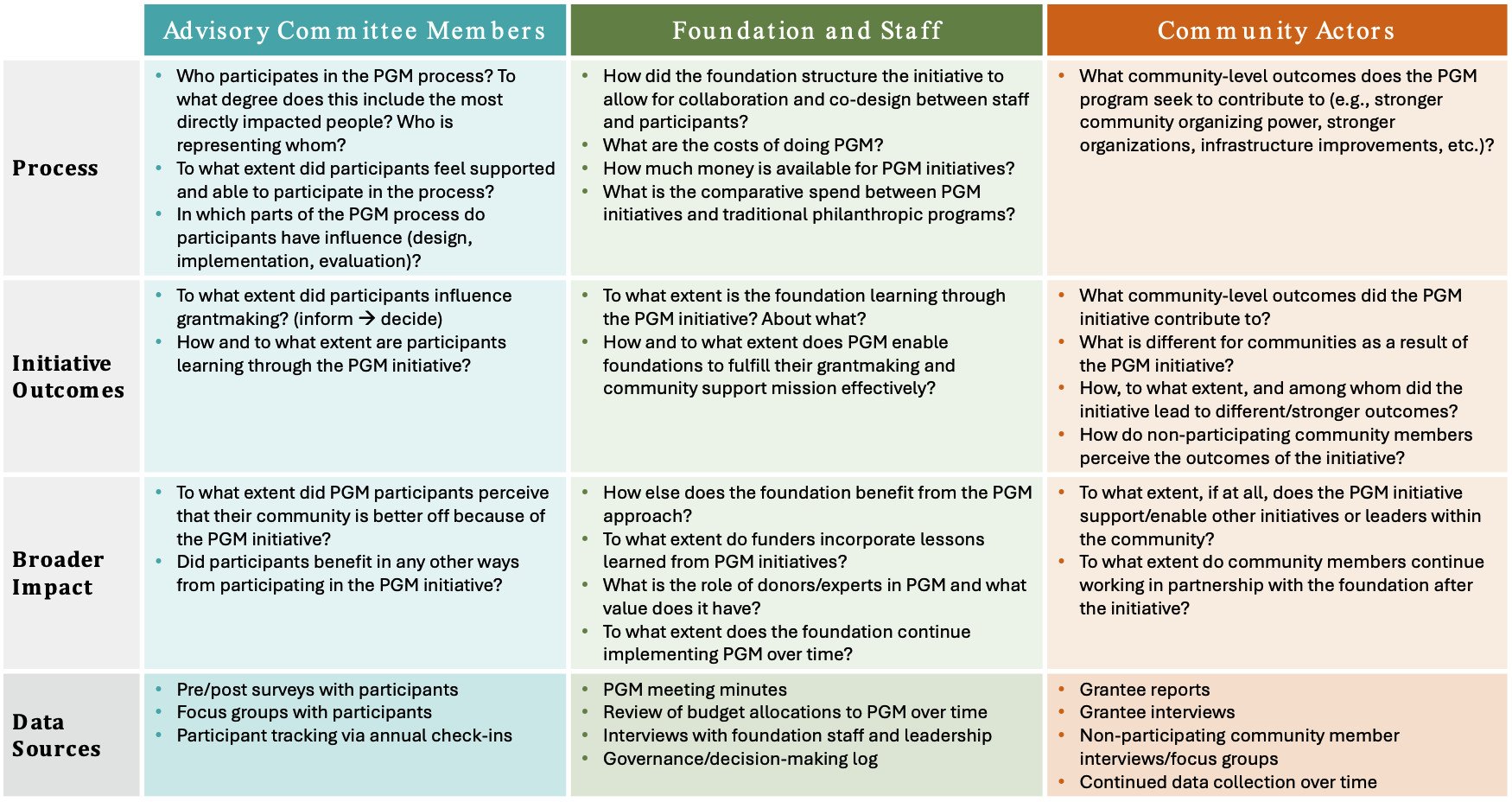
With this framework, foundations can learn about what is working and what can be improved. For example, an evaluation of a participatory grantmaking initiative might show that participants felt heard but were unclear on how their input affected final decisions. It might also show that the initiative informed the broader institution’s norms and practices and contributed (or not) to improved outcomes for the intended community. Evaluation can highlight both specific program improvements and the broader effects of participatory grantmaking on organizations and communities.
What evaluation and learning make visible
Participatory grantmaking holds promise as a strategy for advancing more equitable philanthropic practices. But promise alone is not evidence. Thoughtful evaluation helps the field understand when and how participatory approaches are achieving their aims, where they may fall short, and what it takes to improve them over time.
For foundations seeking to shift power, these insights are vital. Examining both process and outcomes creates space to reflect on whether and how participatory initiatives are reinforcing, redistributing, or reshaping power dynamics. At a moment when many foundations are working to deepen listening and redistribute influence, learning and evaluation help ensure those efforts are grounded in insight as well as intention. Such efforts can also facilitate the development of standards of practice necessary to move the field from awareness to more widespread adoption.
ORS Impact’s studies and framework build on the contributions of Shared Insight and other champions of participatory philanthropy, whose efforts have advanced awareness and adoption across the field. The next step is to continue strengthening the evidence base and standards of practice to facilitate broader and more consistent and effective implementation.
But this is ultimately a collective effort. Individual evaluations can help a single foundation inform its practice, but such isolated learning is not enough to improve the practice or the sector. We therefore invite funders, practitioners, and communities to approach this work with a commitment to learning together. If participatory practices across the sector are to evolve and improve — and live up to their transformational potential — we must learn like we mean it.
What could collective learning look like? If foundation staff and participants engage in systematic and documented learning and evaluation of their participatory grantmaking practices, then we will have a repository of studies to inform discussion. Those documented learnings should then be shared with the field, which takes courage and humility, and also requires venues for sharing and dialogue, such as conferences, publications, and communities of practice. We look forward to increased opportunities to learn together about participatory grantmaking, especially in ways that interrogate practices more deeply, assessing both design and impact, to help move the approach forward.
As Shared Insight’s learning and evaluation partner over the past 12 years, we have had the opportunity to study how listening shows up among foundations and nonprofits. We hope this work supports sector learning and continues contributing to the development, adoption, and evaluation of funder practices that center listening, shift power, and ultimately improve conditions for the communities at the heart of our work.
About the authors:

Jasmine Burnett, Consultant, ORS Impact