I spent much of my career leading human rights and civil rights organizations that were rooted in, and guided by, the communities they partnered with. Whether I was working in Haiti, India, or the United States, one truth consistently emerged: the solutions to the most entrenched challenges are found within the communities most impacted by them. They understand the problems in ways others simply cannot — and they hold the clearest vision of a future where the dream of that community could be realized.
That didn’t mean others weren’t part of the solution; we all had important roles to play. I led U.S.-based organizations, often staffed by lawyers. Our job was to follow community leadership, bring our own tools to the table, and work in service of their vision. Our clarity of purpose — and the future we were building toward — was always guided by our community partners.
In philanthropy, conversations about community voice are not new, but the urgency behind them is. As nonprofits and the communities they serve face escalating and unprecedented challenges and threats, including having their very existence called into question, they are evolving their strategies, supports, and resources to meet the moment. Foundation boards can join them in that evolution and redefine what effective governance looks like. At the heart of this evolution is a simple but transformative question: What becomes possible when communities are not merely consulted, but are truly authentic partners in decision making?
A new resource for foundation boards
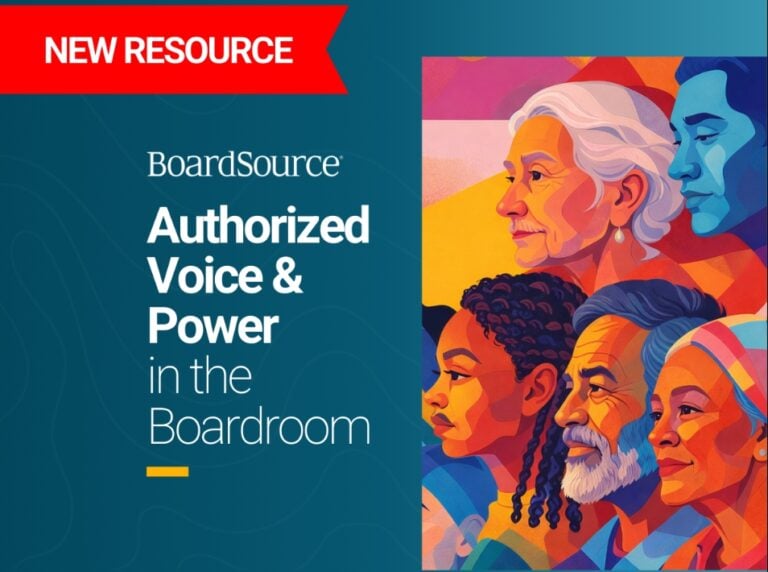
This is the central call of “Authorized Voice & Power in the Boardroom: Reimagining Governance to Fulfill Philanthropy’s Purpose,” a new BoardSource resource developed in partnership with Fund for Shared Insight. It invites foundation boards to reimagine their role not as protectors of institutional legacy, but as stewards of purpose in full partnership with community.
At BoardSource, we have made this shift in our own work, embracing a theory of practice that centers community by listening, learning, and bringing together decades of governance experience to build systems that honor and center the dignity of all. We have also invited organizations across the country to move toward Purpose‑Driven Board Leadership, a framework that helps us fulfill our individual and collective missions with clarity. Together, we are evolving governance to better serve both our organizations and the communities we partner with.
Purpose‑Driven Board Leadership is grounded in four core principles. These principles are not linear; boards move fluidly across and between them:
- Purpose before organization: Anchoring every decision in the organization’s purpose.
- Respect for ecosystem: Recognizing that each organization operates within a broader network of people, policies, histories, and relationships.
- Equity mindset: Committing to equitable outcomes, interrogating how decisions may reinforce systemic inequities, and addressing barriers created in the past.
- Authorized voice and power: Ensuring that the organization’s power and voice are informed and authorized by the communities most impacted by its work.
Our latest resource, tailored for foundation boards, focuses on this fourth principle and serves as a call to action and a guide for organizational transformation. It helps foundation boards:
- Define what it means to share power with community,
- Lead with purpose through a clear and adaptable framework, and
- Implement actionable steps to evolve board structures and culture to center authorized voice and power.
One tool inside the resource is the “Authorized Voice and Power Continuum.” This continuum guides boards to reflect on how voice and power are currently held, shared, or excluded within their governance structures — and assess what work is needed to ensure full representation and inclusion of community voices.
Embracing governance as a catalyst for innovation
Tackling complex and seemingly impossible challenges requires strong governance and visionary leadership. When organizations invest in board development and reimagine their governance structures, they unlock the potential to innovate, deepen trust, and achieve impact.
Change isn’t easy. When I feel stuck, I think back to the communities I worked with around the world. They were always imagining and working toward a different reality — one rooted in dignity, shared power, and collective purpose. Their commitment to that vision never wavered, and as partners, neither did ours.
If we were to design our governance systems today, with that same clarity at the center, would we build them the way they currently exist? Or would we make an unwavering commitment to something more aligned with the future we want to create? “Authorized Voice & Power” invites us to choose the latter.
I hope you will join us in embracing governance as a catalyst for innovation, centering communities in all we do, and believing in the possibility of a new world.
About the author: