Tools & Resources to Shift Power to Communities
Browse Menu
Looking at your role/function within your foundation.
What are listening practices that can shift power?
Assess how you are listening through a set of reflection questions.
How is your foundation accountable and shifting control of assets to impacted communities?
To be more accountable for actually shifting power, foundations can better align with community- and movement-led approaches, ensuring that people with lived and frontline experience play a central role in governing, designing, and directing resources. Accountability also means shifting who holds decision-making power over philanthropic and investment resources, which include not only grants, but also assets.
Q: Are you supporting the social-movement or grassroots organizations and leaders through which impacted communities organize and build their collective power?
Q: How are you aligning the foundation’s strategy and actions with movement or grassroots priorities and values to build community power?
Q: Beyond grantmaking, how aligned are your investments, endowment, and other assets with the priorities and values of communities at the heart of your work? How are you getting community input and feedback to your foundation’s investment strategy?
Q: In what ways are you transferring control over capital to and building wealth for impacted communities?
Get going with these tools and resources
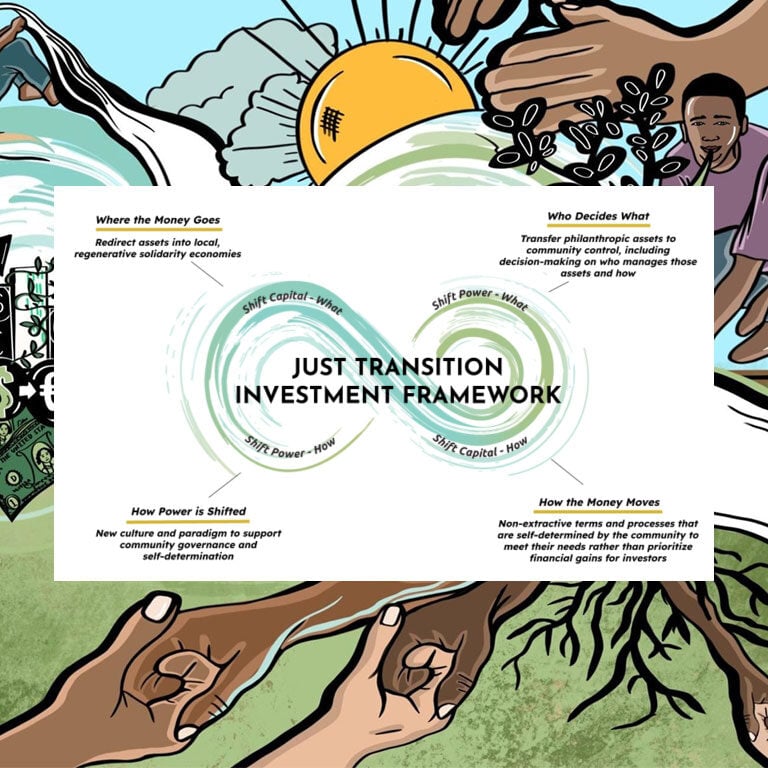
With this toolkit, you’ll learn about Participatory Investing and how your institutions can start integrating the strategies and practices that ensure communities that have been historically excluded and harmed by traditional investment structures hold meaningful power and ownership over capital strategy, design, implementation, and outcomes.

This framework offers a strategy for how funders can shift capital and power to movement-led, community-controlled institutions that build economic power and self-determination. The Just Transition offerings also include a resource library of policies, processes, and materials — based on the experiences of the Just Transition Integrated Capital Fund — that funders can use to apply the framework to their investment practices.
Get inspired by what other funders are doing
“There is a growing recognition that in order to support systemic change that truly advances justice, those of us in philanthropy must do more than redistribute money to movements—we must also intentionally align our grantmaking strategies and redistribute decision-making power over where our funding goes,” the Pink House Foundation’s website reads. Those words accompanied the announcement that Pink House Foundation was transitioning to a “community-driven model” where it would make a smaller number of large, multi-year grants to national grassroots alliances and community-led social justice funds, trusting them to redistribute the money to front-line community organizations according to their own priorities and strategic assessments.
The decision came five years after Pink House Foundation had adopted a new commitment to supporting grassroots movements driving systems change. With that focus, the foundation supported dozens of front-line organizations, learning along the way that the deepest level of strategic alignment and impact could come from empowering community and movement leaders to collectively drive funding decisions. It now provides large, multi-year grants to 10 “redistribution partners that represent an intentional cross-section of movement sectors, communities and geographies.” These include racial justice, economic justice and worker rights, gender and reproductive justice, immigrant rights, climate and environmental justice, and more.
Founded in 1997 as the Consumer Health Foundation, iF, A Foundation for Radical Possibility renamed itself in 2021 to reflect its decades-long evolution from a traditional funder to a community-centered philanthropic partner dedicated to racial justice. The foundation describes its philanthropy as grounded in the belief that those who live at the sharpest intersections of systems of oppression, particularly race, class, and gender identity, should have decision-making power over the distribution of resources in their communities.
The foundation has community members on its governing board and in other leadership positions, implements participatory grantmaking, and works to be in close relationship with grassroots and frontline activists, supporting their organizing, coalition building, and advocacy.
Among those efforts, iF supports a coalition of leaders and organizations advocating for reparations for Black people in Washington, D.C. Upon the invitation of the D.C. Council, iF provided testimony in support of the case for reparations. The city’s reparations legislation passed in 2025, and the coalition is now fighting for its funding and implementation. The foundation continues to work with the coalition on reparations and the broader fight for economic justice.
iF also continues to pilot a worker-led guaranteed income project for D.C.-area hospitality workers who lost their jobs due to COVID-19. Let’s GO (Guarantee Opportunity) DMV! centers workers and includes a strong narrative component to help make the case for permanent, government-supported guaranteed income. The foundation works in partnership with the DC Guaranteed Income Coalition and other pilots and coalitions throughout the region and across the country.

At Headwaters Foundation for Justice, two program funds were built from the ground up by the communities they serve.
The Fund of the Sacred Circle (FSC) emerged from a movement of Native-led philanthropy that sought to push back against what they saw as divestment from Native-led organizations in Minnesota and Wisconsin. They built a Native-led, culturally responsive fund supporting Native-led work with grants decisions made by the fund’s Native Community Grantmaking Circle.
“By having all Native staff and volunteers work on this, it began to change the narrative,” said Joy Persall, a member of FSC’s first grantmaking committee and a former foundation staff member. “People closest to the ground should be making the decisions, that’s self-determination. I felt like philanthropy needed to hear the story from our breath.”
Headwaters’ Black Movement Ecosystem, established by Black organizers to create a network of change makers throughout Minnesota, launched the Justice & Liberation Fund to invest in Black-led organizations working on the frontlines of justice. Funding decisions are made by a community-led grantmaking panel that, like FSC’s grantmaking circles, also reviews grant proposals and leads site visits.
Headwaters supports both funds’ grantmaking panels by providing coaching and training, especially to volunteers without experience in philanthropy, and assistance with policy-setting around issues such as potential conflicts of interest among committee members. The foundation is helping the Justice & Liberation Fund recruit committee members under the age of 25 and over the age of 70 to ensure the group is representative of the multi-generational community it serves. At FSC, Headwaters is working with Native leaders to create an evaluation process that better aligns with Native priorities. For example, in many Indigenous communities, cultural prosperity is more valued than economic prosperity, so they are moving to base evaluations on long-term outcome that are different than what traditional philanthropy typically measures.
Explore this menu to spark the changes you want to see.
Mix and match to find the examples, resources, and reflections best suited to help you and your organization shift power to the people and communities at the heart of your work.
How to use the menu
Funders are moving toward listening and participatory practices at different rates and from different starting points and perspectives. We also know that shifting power is not easy work and requires a strong internal commitment and continuous learning. It’s best to be clear on your organization’s motivations, capabilities, and goals. As you engage with this menu, consider your funding practices, operations, policies, and values — and then identify where change will best serve your foundation and the people and communities you seek to serve.
We recommend examining the menu’s resources and examples with a willingness to turn kernels of ideas into something right for you. No matter where you start or the path you travel through this menu, we suggest spending time on the reflection questions, perhaps engaging colleagues to help you and your organization better understand and prepare for what it means to listen to shift power.
Our Participatory Philanthropy Toolkit, included as a resource in the menu, has a Funder Readiness Assessment that can be adapted to different listening practices and help prepare you to make changes in your priorities and practices.
How we choose the items
We offer a range of examples and resources because there are no one-size-fits-all solutions; and we share them in a menu format so you can choose what’s interesting or relevant to you and your foundation. We don’t rank the practices or the organizations employing them or intend to signal that any featured funder has met its listening goals across the board. Each example represents only a moment in time — a practice one of your peers told us (or an intermediary) about, and that we hope might inspire you to enhance your own listening work.
Similarly, we do not rank the resources, though we did select them based on a set of criteria, including:
- We and/or our partners have personally used the resource and find it is high-quality, promotes impact, and aligns with our power analysis
- The resource is widely and publicly available (not just to paid members) and, ideally, accessible to people with disabilities
- The resource is relevant to, and includes applicable lessons for, a variety of types of funders
- The resource is as evergreen as possible
New resources are always coming online. We hope that the ones we’ve included are helpful while also sparking your curiosity and helping you forge an ongoing relationship with the creators and other aligned efforts.
We are always looking to add more funder listening examples and more resources. Please reach out to our communications manager, Debra Blum, or take a few minutes to share your stories and ideas on our Lift Up Listening online form.
Have questions about the menu or ideas for resources or examples?
Please reach out to our communications manager, Debra Blum.